
Author: Elyssa Pullella
In its recent Getting Major Projects Built discussion paper, the federal government proposes designating Federal Economic Zones across the country. These geographic areas would accelerate transportation, energy, telecommunications and industrial development by pre-approving certain projects and potentially bypassing existing legal requirements. Echoing concerns raised by Ontario’s Bill 5 and its “special economic zones”, the federal proposal raises serious concerns about how meaningful consultation will be conducted, how free, prior and informed consent will be obtained, and how constitutional rights and democratic accountability will be protected.
Impacts on Canada's Duty to Consult and Accommodate
Federal Economic Zones are a new concept in Canadian environmental law, but the Crown’s constitutional obligations are not. Section 35 of the Constitution Act, 1982 recognizes and affirms the existing Aboriginal and Treaty rights of Indigenous Peoples. In the 2004 landmark decision, Haida Nation v British Columbia (Minister of Forests), the Supreme Court of Canada established that the Crown has a legal duty to consult, and where appropriate, accommodate Indigenous Peoples before authorizing conduct that may adversely affect potential Aboriginal rights or title of which it has “real or constructive” knowledge. Haida Nation also makes clear that consultation must be conducted in good faith and that its scope depends on the strength of the asserted right and the seriousness of the potential harm.
Despite these established obligations, the discussion paper provides little indication of how Canada will meaningfully satisfy its duty. It states only that Indigenous Peoples will be a “key part” of identifying impacts and opportunities. However, given that these zones will unequivocally affect Indigenous lands, livelihoods, environmental stewardship, and cultural practices and ways of life, Canada must consult on each proposed zone, including its boundaries, laws being waived and activities permitted, as well as on specific projects. Project-level consultation is necessary because affected Nations can only understand the actual impacts once a project’s location, scale and effects are known. Consultation must occur before legislation and zone plans are finalized; otherwise, pre-approval risks making consultation merely performative.
"Pre-Approved" Projects Threaten Free, Prior and Informed Consent
Canada’s obligations concerning free, prior and informed consent raise another set of unanswered questions. The United Nations Declaration on the Rights of Indigenous Peoples (UNDRIP) sets out 46 individual and collective rights of Indigenous Peoples. Canada endorsed UNDRIP in 2016 and passed the United Nations Declaration on the Rights of Indigenous Peoples Act (UNDA) in 2021, requiring federal laws to be brought into alignment with UNDRIP. Article 19 requires governments to consult and cooperate in good faith to obtain Indigenous Peoples’ free, prior and informed consent before implementing measures that may affect them. In Kebaowek First Nation v Canadian Nuclear Laboratories, the Federal Court described FPIC as requiring a robust process that makes consent the objective of consultation.
Yet the discussion paper does not explain how FPIC will be sought at either of the two necessary stages: first, before a zone is established, and second, before individual projects within it are approved. This omission is especially concerning because the proposal involves pre-approving projects. Zone-level consultation cannot amount to advance consent for every future project. Indigenous Nations must have the opportunity to provide or withhold consent at the project-specific stage, once the development’s location, scale and actual impacts are known.
The Proposal Echoes Constitutional Concerns Raised by Ontario’s Special Economic Zones Act
These concerns are not hypothetical; they closely resemble issues already before the courts in challenges to Ontario’s 2025 Bill 5 and the federal Bill C-5. Like Ontario’s Special Economic Zones Act (SEZA), the federal proposal would allow Cabinet to pre-approve development within designated areas and weaken the legal requirements that ordinarily apply.
In July 2025, nine First Nations challenged Bill 5 and Bill C-5, arguing these laws violate section 35 of the Constitution Act, 1982, by granting federal and provincial governments broad, unilateral decision-making powers without meaningful Indigenous participation. The challenge also raises Charter concerns. Specifically engaging section 7, rights to life, liberty and security of the person as weakened protections for land threaten access to food, drinking water and a safe environment, and section 15 equality rights, as reduced protections and diminished self-determination deepen the disadvantages created by colonialism and displacement. By adopting the same model of pre-approval and concentrated Cabinet power, Proposal 5 is vulnerable to the same constitutional challenges and, consequently, costly, time-consuming, divisive litigation that will further delay development.
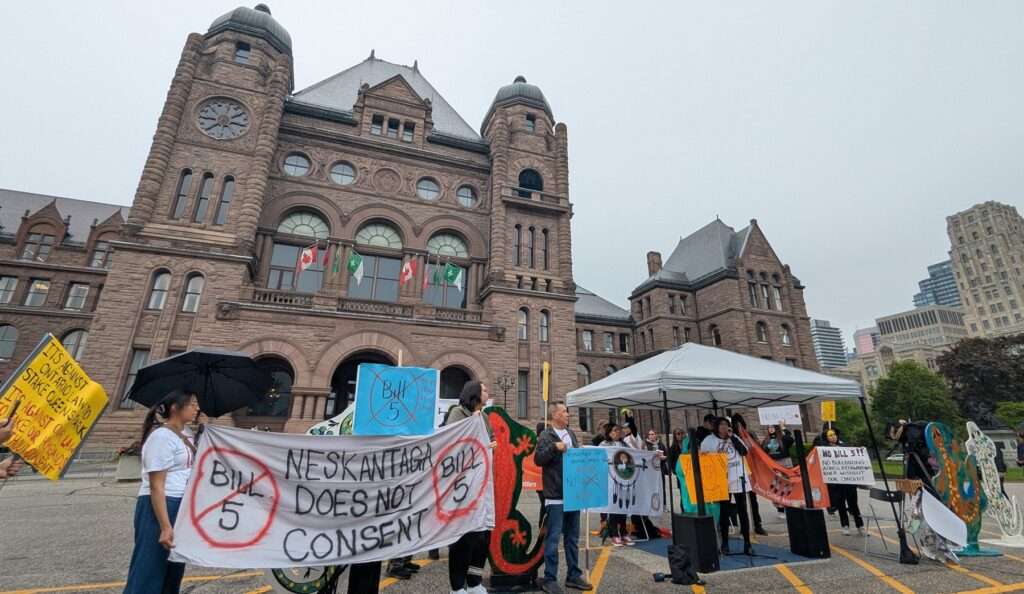
Image source: Infrastructure Beyond Extractivism, “First Nations Rally Against Bill 5, Doug Ford’s Latest Attack on Indigenous Jurisdiction (in Treaty No. 9 and Beyond)” (17 July 2025), online: https://jurisdiction-infrastructure.com/first-nations-rally-against-bill-5/.
Risks to Canadians' Democratic Rights Posed by "Henry the VIII Clauses"
Beyond its implications for Indigenous and constitutional rights, Proposal 5 also raises serious concerns about democratic accountability. The discussion paper suggests that the Governor in Council will decide which developments proceed within Federal Economic Zones and whether existing legal requirements will apply. These broad powers, referred to as “Henry VIII clauses”, allow the executive to amend, adapt or suspend legislation, authority traditionally vested in the legislature. This transfer reduces parliamentary scrutiny, debate and transparency typically provided by the legislature while concentrating significant power in Cabinet. Similar concerns have already been raised about Ontario’s Bill 5, where critics argued that broad executive powers weaken democratic processes and threatens environmental and Indigenous rights. Ecojustice has challenged Ontario’s Special Economic Zones Act on the basis that the Legislature cannot give Cabinet the power to suspend laws at will. Proposal 5 risks repeating the same mistake by concentrating enormous authority in Cabinet while weakening the safeguards meant to hold the government accountable.
Conclusion
While Proposal 5 lacks clarity about how Federal Economic Zones would operate, its risks are already clear. Moving forward without addressing these concerns will weaken environmental protections, invite conflict and litigation, and cause further harm to Crown-Indigenous relations.
The full federal discussion paper can be found here.
