
Author: Haidi Wu
On May 08, 2026, the federal government posted the Getting Major Projects Built in Canada Discussion Paper on Proposed Legislative, Regulatory, and Policy Reforms. The Discussion Paper proposed several changes that would continue the fast-tracking and de-regulating agenda in Bill C-5, the Building Canada Act and Bill 5, the Protect Ontario by Unleashing our Economy Act.
The discussion paper was initially released for public comment for a mere 30 days until June 07, but after a backlash, the deadline was later extended to July 22. There are 6 distinct Proposals outlined in the Discussion Paper. Here, we focus on the implications of Proposal 5 to bypass Impact Assessments using “Federal Economic Zones”.
What is Proposed:
In Proposal 5, Canada says it will use Regional Assessments to create Federal Economic Zones, which “would remove the need for separate project reviews”. If legislation passes implementing this proposal, the Parliament would give the Governor in Council (a.k.a. the federal Cabinet) the authorization to pre-approve “certain developments” inside these zones.
Why it is Dangerous:
- Because Regional Assessments can see the big picture, including cumulative effects, they should inform, but not replace, Impact Assessments for individual projects;
- Individual project-level Impact Assessments play a key role in meeting the duty to consult and accommodate because they provide a structured framework through which affected communities learn about, and begin to understand, the likely impacts of proposed projects;
- Approvals are not granted until investigations are complete so that decisions can be reversed if the projects are deemed too risky. The reason Canada, and most other countries in the world, conduct Impact Assessments, is that they can help predict the lasting effects and dangers associated with proposed projects. They are crucial to avoiding environmental disasters. There are basic requirements to conduct Environmental Impact Assessment grounded in customary international law that Canada cannot avoid.
Regional Assessments Must Inform, Not replace, Impact Assessments
In 2017, Canada initiated a review of environmental assessment processes. As part of their findings, the review panel suggested that Regional Assessments could “play a major role in managing cumulative impacts” and addressing their impacts on Indigenous rights. These include Aboriginal and treaty rights protected by Section 35 of the Constitution Act, 1982, as well as the right to free, prior and informed consent (FPIC) upheld in the UN Declaration on the Rights of Indigenous Peoples.
In West Moberly First Nations v British Columbia, 2011, the BC Court of Appeal ruled that the duty to consult and accommodate includes considering historical and future impacts. The review panel proposed that Regional Assessments could feed into and support individual project-level Impact Assessments (IAs) in meeting this requirement, which would streamline and strengthen IAs.
Canada’s proposal to use Regional Assessments to allow projects to go forward without IAs would thus undermine their intended purpose.
The Ring of Fire as a Case Study: Impact Assessment and the Duty to Consult and Accommodate
Our position here is informed by our work in solidarity with Neskantaga First Nation, a remote Anishinaabe community in the Treaty No.9 territory of the far north of Ontario. The community faces potentially irreversible changes to their way of life from Ring of Fire mining development.
Road infrastructure to support mineral extraction is already being accelerated. Additionally, the proposed Eagle’s Nest nickel mine, which represents the most advanced project in the region, will not undergo a provincial environmental assessment or federal Impact Assessment (IA). Meanwhile, there is inadequate support for infrastructure critical to the community’s well-being— such as housing, access to health services and access to clean drinking water. This contrast became apparent in the lack of communication from the provincial and federal governments as the community was displaced by recent wildfires.
The Ring of Fire is subject to one of the six ongoing or completed Regional Assessments and the first to be conducted in partnership with Indigenous Nations. The Terms of Reference re-affirm that Regional Assessments “do not replace the need for project-specific assessments.” We are troubled by what would happen if Regional Assessments were used to pre-approve projects here or elsewhere.
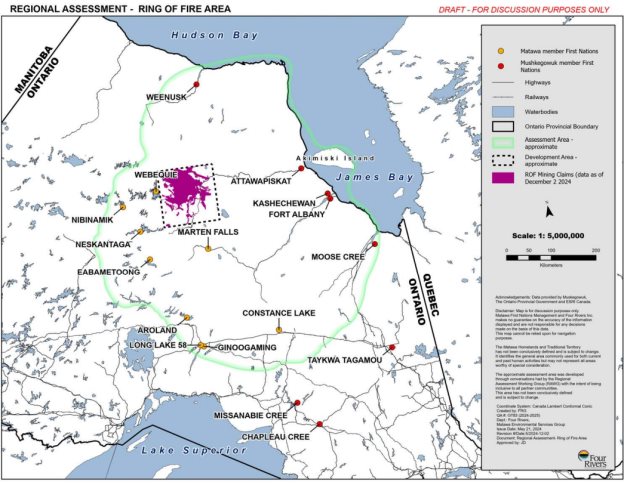
This spring, Neskantaga First Nation submitted a request to the Impact Assessment Agency of Canada to have the Eagle’s Nest mine designated for a federal IA. The First Nation stated that through providing a structure to understand and discuss potential impacts on Indigenous rights and the Crown’s obligations, IA represents “one of the main tools the Crown has used to discharge its duty to consult and accommodate.”
The Agency also received comments supporting designation from 7 out of the 14 Nations it contacted (those 7 were Attawapiskat First Nation, Fort Albany First Nation, Ginoogaming First Nation, Moose Cree First Nation, Nibinamik First Nation, Weenusk First Nation and Kitchenuhmaykoosib Inninuwug). Notably, Moose Cree First Nation and Nibinamik First Nation’s comments stated that failing to designate the project would breach the trust built through the Regional Assessment process.
Environmental Impact Assessments and International Law
Environmental Impact Assessments (EIA) are a globally accepted legal norm. They are encouraged in Principle 17 in the 1992 Rio Declaration on Environment and Development and Article 14 of the Convention on Biological Diversity. Requirements to conduct an EIA are found in the domestic law of nearly every country, and in the policies of 5 multi-lateral development banks including the World Bank.
Legal scholar Tseming Yang confirms that due to this near-universal adoption, the “EIA duty” represents a General Principle of Law. Under Article 38(1) of the Statute of the International Court of Justice, a General Principle is an identifiable legal principle that is recognized as law and accepted by “civilized nations”.
International case law already confirms that EIAs implement the customary law obligation to exercise due diligence in preventing transboundary environmental harm (para. 204). However, Yang explains that the EIA duty being a General Principle extends this obligation to “the global commons”. The global commons include climate stability and biodiversity: shared, interconnected resources that sustain life on Earth.
Canada must back-track on this fast-track.
